Bvatar Farm — Farming Game Prototype
A learning project using Unity and C#: an offline farming loop with a separate ASP.NET Core and PostgreSQL backend prototype.
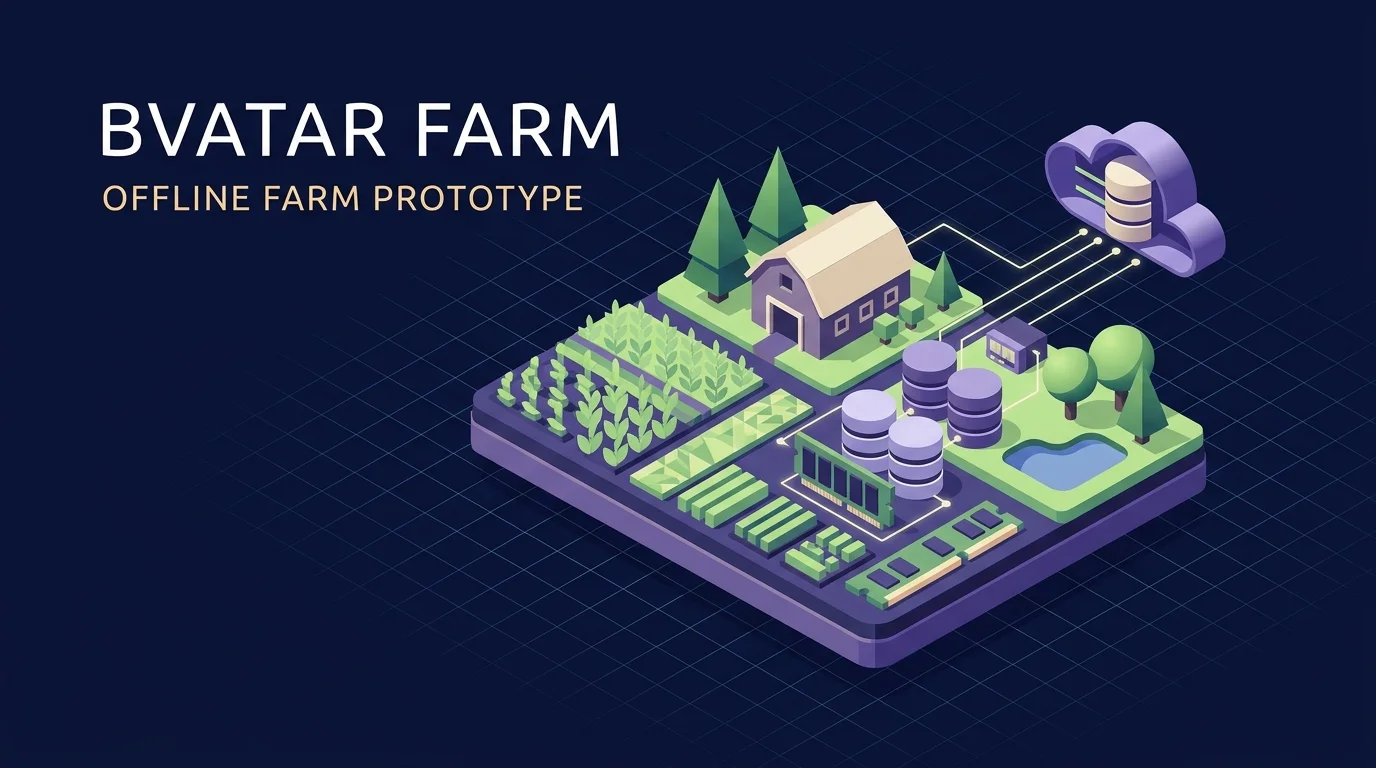
This is an AI-generated concept illustration using original geometric farm imagery, not a game screenshot. It does not use extracted game assets.
Overview: exploring a stateful game loop
Bvatar Farm is a personal learning project exploring farming mechanics with Unity and C#. Actions such as planting, harvesting, or moving a building introduce questions about time, resources, persistence, and valid state transitions.
The project has two distinct scopes: an offline Unity client with a richer gameplay loop, and a separate ASP.NET Core/PostgreSQL backend prototype covering a smaller MVP. The client is not a fully integrated online game.
The gameplay loop
Farming and resource management
Players prepare soil, plant seeds, water and care for crops, harvest, and sell or reuse the produce. The client includes 29 crop types. Planting times, care requirements, and harvest readiness are persisted state rather than merely visual effects.
Livestock, cooking, and orders
Housing, feed, and animal products add another resource-management layer. Crops and livestock products can become cooking ingredients. The order board consumes items already in inventory and rewards coins and XP, guiding progression through crop and recipe unlocks.
Building and expansion
Players buy land, place or move objects, and store and restore decorations. Some construction actions support drag-to-place rows and command-level undo. Actions that change resources or progression cannot be treated as freely reversible visual edits.
Two technical tracks
| Track | Scope |
|---|---|
| Unity / C# | Offline rules, interface, land layout, and persistence |
| PlayerPrefs | Local progress with versioned state |
| ASP.NET Core 8 | Prototype planting, harvesting, and selling APIs |
| PostgreSQL | Transactions, per-farm locking, inventory, and ledger |
The backend MVP implements its original five crops. It does not yet support the client's full livestock, cooking, order, land, or building systems.
Notable engineering challenges
Evolving saves without losing progress. Adding layout or progression systems requires recognizing legacy data and preserving existing unlocks. Migrations retain corresponding backups rather than treating every save as a fresh player profile.
Repeated commands should not create extra rewards. The backend uses idempotency receipts: retrying a successful request returns its recorded result. Reusing the identifier with different inputs is rejected. Transactions and per-farm locking model resource changes as a single business operation.
Distinguishing simulation time from trusted state. Database timestamps determine crop readiness in the backend prototype. The offline client stores state locally; the project does not claim save-tampering protection or anti-cheat guarantees.
Limitations and future direction
This is a learning prototype, not a production product. The backend lacks production authentication and the integration/database verification needed for operational guarantees. Bringing richer client mechanics online would require explicit data contracts rather than assuming the existing MVP already supports them.
This page describes technical work only. It does not distribute game assets, installers, or screenshots containing assets with unverified rights. The cover illustration was created specifically for this portfolio.