Asia Uniform — B2B Garment Management Platform
A personal project combining a CMS, product catalog, and B2B sales workflows from quotation requests to sales orders.
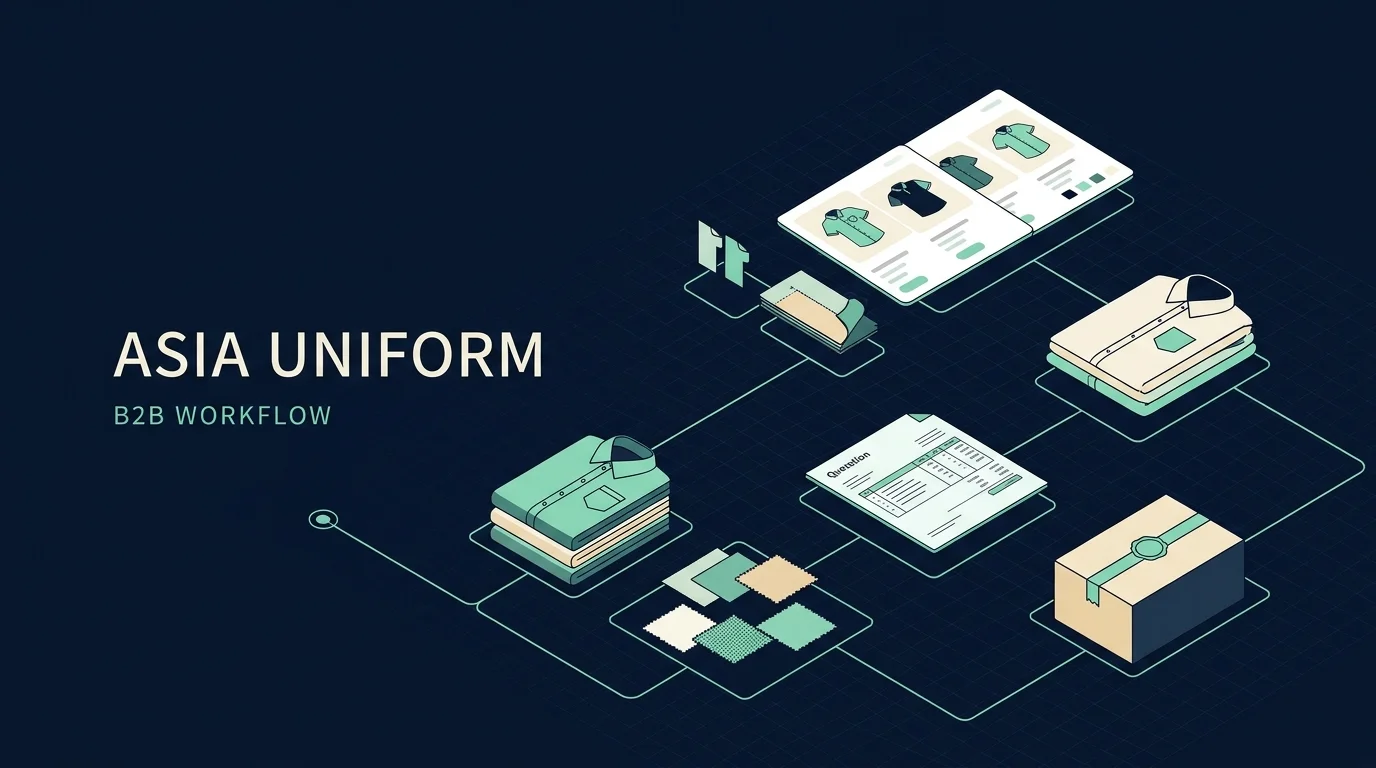
The cover is an AI-generated concept illustration, not a screenshot of the application.
The problem: more than a company website
B2B garment sales rarely end with a product listing. Buyers need to submit requirements, discuss details, review quotations, and agree on terms before an order is created. Website content, product data, and sales records therefore need to work as a connected workflow.
Asia Uniform is a personal project combining a CMS, product catalog, CRM, and request-to-order sales workflow. It is not presented on behalf of Kmin Academy.
The business journey
1. Present products and capture requirements
The catalog manages categories, products, variants, and related documents. The CMS manages pages, articles, services, and projects, with public endpoints exposing published content only. Buyers submit a request for quotation rather than immediately placing a fixed-price order.
2. Move from customer records to quotations
The CRM stores customers and contacts. RFQs are assigned to sales staff for processing. Quotations support revisions, reflecting the back-and-forth that happens before an agreement. Admin, sales, and content-editor roles separate publishing tasks from sales operations.
3. Preserve the agreement in an order
An accepted quotation can become a sales order. Line items and terms are snapshotted, so the resulting order preserves the agreed information instead of depending entirely on catalog data that may change later.
Architecture and technology
| Component | Technology / approach |
|---|---|
| Backend | Go, Chi, business-oriented modules |
| Persistence | SQLite, database/sql, parameterized SQL |
| Administration | React, TypeScript, Vite, shadcn/ui |
| API contract | OpenAPI |
| Authentication | Session cookies and role checks |
| Traceability | Audit records within business transactions |
Catalog, CRM, CMS, RFQs, quotations, and orders are organized as separate business modules. This keeps related behavior discoverable without requiring independently deployed services.
Notable engineering decisions
Different kinds of history need different models. Quotation revisions track negotiation, while order snapshots preserve the final agreement. Treating these as separate concerns makes the workflow easier to reason about.
Record audit information with the change. Business mutations and their audit records share a transaction. This avoids a successful data update being separated from its corresponding operation history.
Permissions follow responsibilities. Sales access is scoped to assignments; content editors focus on content and catalog work. These are business boundaries rather than merely hidden interface buttons.
Current scope and next steps
The repository describes a single-tenant system. Production deployment still requires attention to gateway rate limits, trusted reverse-proxy policies, HTTPS, and SQLite/media backups. No customer counts, revenue figures, or performance improvements are claimed.
A public demo will be added later. This case study describes the design and functionality without linking the private source repository.